Wednesday, February 21, 2018

The talented 4/5s ( and family) performing at the Variety Show.  They were fabulous!


After learning more about the ancient Maya civilization, including codices, glyphs, and stelis, students designed their own original Maya glyphs.


Inca Weaving & Textiles
Inca weaving is one of the greatest textile arts the world has ever seen, and one of the most important craft of the Incas. Wool was used from llamas and alpaca, but the Incas also used the extremely fine wool of the vicuna, the smallest American camel.
Llama wool was used to make blankets and ropes. Alpaca wool was used to weave clothing. The wool from the vicuna was the softest fiber and was used to weave their finest cloth.
Students made observations and explored detailed and intricate Inca weaving.  Students then wove their own original pieces inspired by Inca textiles.  These included belts, placemats, coasters, blankets and tunics.


Math 4 students shared their imaginative 
Theme Park Projects.


Students also learned how to use a protractor to 
accurately measure and draw angles.

Discussing strategies for calculating area and perimeter of polygons.


Monday, January 29, 2018


The 4/5s have been exploring ancient civilizations.

 Our study will focus on the fascinating 
Aztecs, Incas, and Mayas 

Students learned about and then constructed Aztec calendars 

Aztec Calendar Wheels, Central America, 1000 BCE
There is not just one Aztec calendar, but two independent systems. One calendar has 365 days, and therefore might be called the agricultural or the solar year.  In this time measuring calendar, one year had 365 days, divided into 18 months.  Each month has 20 days, and there are 5 extra days at the end of the year, which were thought to be bad luck days.  

The other calendar (the festival calendar) has 260 days. In the language of the Aztecs, it is called the tonalpohualli or, the day-count.  The system of the tonalpohualli can be best understood by imagining two wheels that are connected to each other. One wheel has the numbers "one" to "thirteen" written on it. The second wheel has twenty symbols on it. In the initial situation, number "one" combines with the first symbol (glyph). This is the first day of thetonalpohualli. Now the wheels start moving and number "two" combines with the second glyph. This is the second day. On the fourteenth day, a new Aztec week starts. The wheel with the numbers shows number "one" again. The other wheel now shows the fourteenth symbol. After 260 days, the two wheels have returned to their initial position. The tonalpohualli starts all over again.

Dividing time among gods - A day in the tonalpohualli consists of a number and a symbol or daysign. Each daysign is dedicated to a god.


         Students constructing their own Aztec calendars.


      Math 4 students presenting their
           Data Collection Projects


Saturday, December 30, 2017

The 4/5 Students had an incredible experience visiting A Child’s Place of Unity House in Troy.  They had the opportunity to read their original Native American Legends and Myths to the pre-school students.  A copy of each book, along with hand-sewn animals related to the story, were left as gifts.


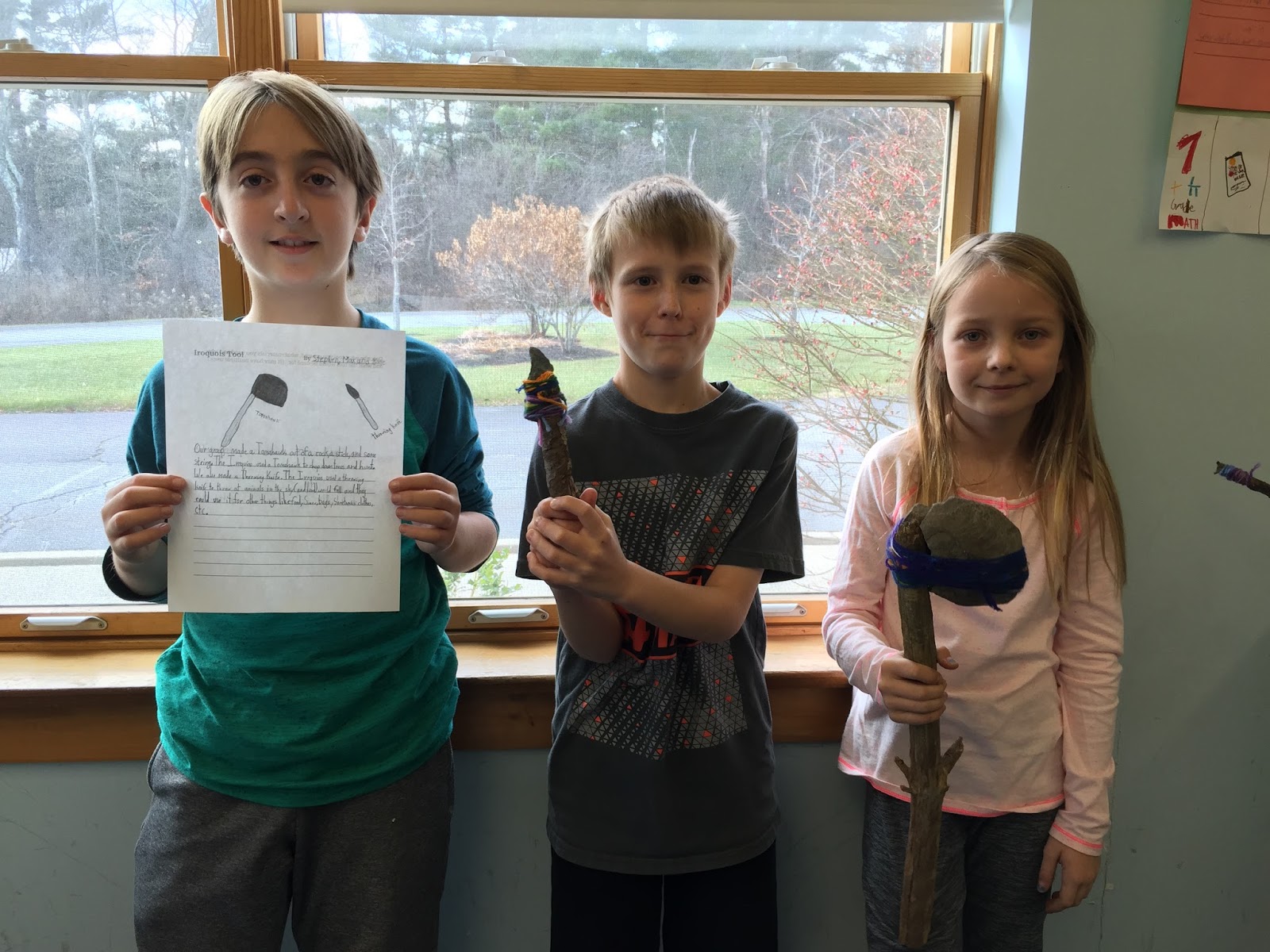
Students learned about Iroquois tools then gathered materials they found while exploring the woods at Parker. Students constructed their own tools from these materials. Successful construction required imagination, thinking outside the box, and problem solving skills.

Gathering materials....


..... and the tools


Math 4 students eagerly analyzed their results from their Data Collection surveys.


Parker School’s annual Special Friends Day was enjoyed by students and family members!